
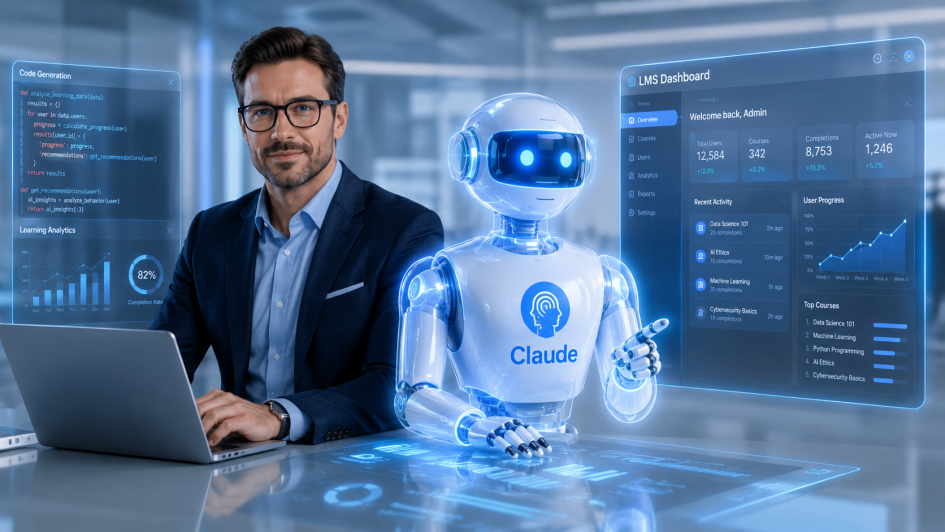
Artificial intelligence has taken a dramatic leap forward in 2026. Anthropic’s Claude — arguably the most capable and nuanced AI assistant available today — has introduced a wave of new features that are reshaping how developers, businesses, and teams work. From writing production-ready code autonomously to managing complex multi-step workflows, Claude is doing things that seemed impossible just two years ago.
And yet, the headlines about AI “replacing” human expertise keep getting it wrong.
Here is an honest, expert look at what Claude can genuinely do in 2026 — and why the most skilled professionals are using it to become more indispensable, not less.
What Is Claude AI? A Quick Primer
Claude is an AI assistant built by Anthropic, a safety-focused AI research company. Unlike many AI tools that chase raw performance benchmarks, Claude is designed around a core principle: being helpful, harmless, and honest. It comes in three model tiers — Haiku (fast and lightweight), Sonnet (balanced performance), and Opus (most capable) — each suited to different tasks and budgets.
In 2026, Claude has evolved far beyond a simple chatbot. It is now a full agentic AI platform — capable of using tools, browsing the web, writing and executing code, analysing documents, and completing multi-step tasks with minimal human hand-holding.
Claude’s Latest Features in 2026
1. Claude Opus 4 — The Most Capable Model Yet
The flagship Claude Opus 4 (released April 2026) raises the bar across every benchmark. It delivers significantly stronger performance in:
- Coding — writes, debugs, and refactors complex codebases across Python, PHP, JavaScript, Laravel, React, and more
- Agentic tasks — completes long, multi-step workflows that span hours, not seconds
- Vision — analyses diagrams, screenshots, PDFs, spreadsheets, and images with remarkable accuracy
- Reasoning — handles nuanced, multi-variable problems with greater depth and consistency than any previous model
For developers and business teams, Opus 4 is the difference between an AI that helps draft an email and one that can actually help architect a software system.
2. Extended Thinking — AI That Shows Its Work
One of Claude’s most powerful but underappreciated features is Extended Thinking. Before giving you an answer, Claude works through the problem step-by-step internally — weighing different approaches, checking assumptions, and stress-testing its reasoning.
The result? Answers that are more accurate, more nuanced, and far less prone to the confident-sounding errors that plagued earlier AI models. For tasks like technical architecture decisions, compliance analysis, or financial modelling, Extended Thinking transforms Claude from a fast guesser into a reliable analytical partner.
3. Claude Code — Autonomous Software Development
Claude Code is a dedicated product for software development that goes far beyond code completion. It can:
- Understand an entire codebase — not just a single file
- Write new features based on natural language descriptions
- Identify and fix bugs across multiple interconnected files
- Refactor legacy code to modern standards
- Run terminal commands and manage files autonomously
- Integrate into your existing IDE workflow
In practical terms, Claude Code can take a task like “Build a REST API endpoint that pulls Moodle enrolment data and pushes it to HubSpot” and actually complete it — writing the code, testing it, and flagging issues — without needing step-by-step instructions.
4. Claude Cowork — Delegate Tasks, Step Away, Come Back to Results
Claude Cowork represents a fundamental shift in how AI handles work. Rather than answering one question at a time, Cowork lets you describe the outcome you need, connect it to your local files and cloud apps (Google Drive, Notion, Slack, Jira), step away, and come back to completed work. It is, in essence, a capable AI team member who handles execution — not just advice.
5. Projects — Persistent Memory and Context
Projects solve one of the biggest frustrations with AI tools: the lack of memory. With Projects, Claude maintains persistent context across all your conversations on a given topic. You can upload your company’s style guide, technical documentation, product specs, or compliance requirements once — and Claude will reference them consistently across every subsequent conversation, without you having to paste them in each time.
6. Artifacts — Instantly Deployable Outputs
Artifacts lets Claude generate more than text. You can ask it to build interactive data visualisations, working web apps and tools, presentations and slide decks, and shareable dashboards. These are not mockups — they are functional, deployable outputs created in seconds from a plain-English description.
7. Broad Integrations — Claude Inside Your Entire Stack
Claude now integrates natively with Microsoft Office (Excel, Word, PowerPoint), Google Workspace (Gmail, Docs, Calendar), Slack, Chrome, Zapier, Jira, Intercom, and custom enterprise integrations via API. Claude is not just a tab you open — it is embedded into the tools your team already uses every day.
8. Voice Mode and Multimodal Input
Claude now supports voice conversations — switch between typing and speaking fluidly. Combined with its image, PDF, and document analysis capabilities, Claude can process virtually any form of input and respond intelligently.
So… Are Humans Still Needed?
With capabilities this broad, the question is fair. If Claude can write code, manage workflows, analyse documents, and build tools — what exactly is left for humans to do? The answer is: everything that actually matters.
1. Claude Cannot Understand Your Client
Claude can write a technically perfect API. It cannot understand that your client has just switched project managers, has a new compliance requirement they mentioned casually in a meeting, and is about to change the scope entirely. Human professionals build relationships. They read between the lines. They manage expectations and politics. They know when to push back and when to absorb pressure. Claude does not understand people — it understands text.
The businesses winning with AI in 2026 are the ones whose teams are deeply human in their client relationships, and use AI to handle execution.
2. Claude Cannot Take Accountability
When a project goes wrong — and sometimes they do — someone has to own it. Explain what happened, take responsibility, and chart the path forward. Claude cannot sit across the table from an angry client. It cannot make a judgement call at 11pm when everything is at risk and the answer is not in any document. Accountability is inherently human. It requires reputation, experience, and trust built over years — none of which an AI model possesses.
3. Claude Makes Confident Mistakes Without Expert Oversight
Claude is extraordinarily capable — and occasionally, spectacularly wrong. It can generate code that looks perfect but contains a subtle security vulnerability. It can summarise a legal document accurately in nine out of ten points and miss the one clause that changes everything. Without a skilled human reviewing, validating, and catching these errors, AI output is not a finished product — it is a first draft that could cause serious damage. The more powerful the AI, the more dangerous unchecked errors become. Expertise is the quality gate.
4. Claude Cannot Define What “Good” Looks Like
Before Claude can solve a problem, someone has to correctly define the problem. This is harder than it sounds. A Moodle LMS project is not “install Moodle and add some plugins.” It is: understanding the RTO’s specific compliance obligations, the learners’ literacy levels, the trainer’s technical confidence, the budget constraints, the integration with an existing student management system, and the regulatory reporting format required by ASQA. Claude can execute brilliantly once the brief is right. Getting the brief right requires domain expertise, experience, and deep listening — all human skills.
5. Ethics, Strategy, and Creative Vision Cannot Be Automated
The most valuable decisions in any business are not the ones that can be computed. They are the ones that require weighing competing values, imagining futures that do not yet exist, and choosing a direction under genuine uncertainty. Should you build on Moodle or a custom LMS? Should you expand into the UK market now or wait? These are strategic questions. Claude can model scenarios and surface information — but the judgement is irreducibly human.
The Right Mental Model: Claude as a Force Multiplier
The professionals thriving in 2026 are not those ignoring AI, nor those blindly delegating to it. They are the ones who have internalised a clear mental model:
Claude accelerates execution. Humans provide direction, judgement, and accountability.
A skilled Moodle developer using Claude Code does not become unnecessary — they become capable of delivering in one week what used to take three. A project manager using Claude Cowork does not become redundant — they free up hours previously spent on status updates for the strategic thinking that clients actually pay for.
How Vibidsoft Uses Claude AI in Real Projects
At Vibidsoft, we have integrated Claude into our Moodle LMS development workflow, custom software projects, and client communication processes. Here is what that looks like in practice:
- Moodle plugin development: Claude Code accelerates initial scaffolding and boilerplate; our developers architect the approach, validate the logic, and handle client-specific compliance requirements
- LMS integration work: Claude maps API structures and generates integration code; our team validates data flows, tests edge cases, and ensures zero data loss
- Client proposals: Claude drafts initial scopes; our experienced consultants refine the language and ensure the proposal reflects what we can actually deliver
- AI chatbot tutor setup: Claude provides the underlying intelligence; our team trains it on client-specific course content, tests its responses, and monitors quality
The result is faster delivery, higher quality, and more time for our team to focus on the work that requires human judgement — which is ultimately what our clients pay us for.
What This Means for Your Business
Claude is extraordinary. It will save your team hundreds of hours and produce outputs that would have been impossible to generate at this speed and quality two years ago. But Claude is not a strategy. It is not a relationship. It is not a guarantee. And it is not accountable.
The businesses that will win in the next five years are those who invest in two things simultaneously: the best AI tools available, and the human expertise to direct them. If you are looking to build or upgrade an AI-powered LMS, automate compliance workflows, or integrate Claude into your Moodle platform — the combination of Claude’s capabilities and Vibidsoft’s 12 years of LMS expertise is exactly that combination.
Talk to our team → Free 30-minute consultation
Frequently Asked Questions
What is Claude AI’s latest version in 2026?
As of 2026, Anthropic’s latest flagship model is Claude Opus 4, offering enhanced coding, reasoning, vision, and agentic capabilities. It is available via Claude.ai and the Anthropic API.
Can Claude AI replace software developers?
No. Claude can dramatically accelerate development tasks, but skilled developers are needed to architect solutions, validate outputs, handle edge cases, manage clients, and take accountability for production systems.
What is Claude Code?
Claude Code is Anthropic’s dedicated software development product. It can understand entire codebases, write and debug code, run terminal commands, and complete multi-step development tasks autonomously — within a human-supervised workflow.
What is Extended Thinking in Claude?
Extended Thinking is a reasoning mode where Claude works through problems step-by-step before responding, producing more accurate and nuanced answers for complex tasks.
How can Moodle developers use Claude AI?
Moodle developers can use Claude for plugin scaffolding, API integration code generation, compliance documentation, and test case creation — while maintaining human oversight for architecture, validation, and client-specific requirements.
Is Claude AI safe to use for business?
Claude is built by Anthropic with a strong focus on safety and helpfulness. For business use, it is important to review all AI-generated outputs with qualified professionals before deploying to production environments.
Vibidsoft Pvt Ltd is a Moodle™ LMS development company with 12+ years of experience and 350+ projects delivered across Australia, UK, USA, UAE, Singapore, Canada and India. We build AI-powered Moodle™ solutions that combine the best of Claude AI capabilities with expert human development.